


IIBA CCBA Premium Exam Engine pdf - Download Free Updated 633 Questions
Verified CCBA Bundle Real Exam Dumps PDF
The CCBA certification is highly valued by employers around the world as it is an indication of an individual's proficiency in business analysis. It is also a valuable asset for individuals who are looking to advance their career in the field of business analysis. CCBA certified professionals are equipped with the knowledge and skills to effectively analyze business problems, develop solutions, and communicate with stakeholders. Furthermore, the CCBA certification is a stepping stone to the more advanced Certified Business Analysis Professional (CBAP) certification offered by the IIBA.
The Certification of Capability in Business Analysis (CCBA) is a highly recognized credential offered by the International Institute of Business Analysis (IIBA). Certification of Capability in Business Analysis (CCBA) certification is designed for professionals who want to demonstrate their capability and proficiency in business analysis. It requires applicants to have at least two years of experience in business analysis, as well as other eligibility criteria.
NEW QUESTION # 43
A business analyst in her organization has identified all of the terminology of the solution, the acronyms the organization will use, and the nomenclature of her department where the endeavor will take place. Where should all of this information actually be stored?
- A. Business analysis register
- B. Data dictionary
- C. Terminology register
- D. WBS
Answer: B
NEW QUESTION # 44
The business analyst (BA) recommended a new application be rolled out in phases. After reviewing alternatives, the project sponsor agreed. What does the BA expect to achieve by this approach?
- A. Maximize allocation
- B. Maximize benefits
- C. Increase stakeholder engagement
- D. Increase process validation
Answer: B
Explanation:
The scenario describes a task that involves recommending a phased rollout of a new application. The phased rollout is a technique used by business analysts to deliver the solution incrementally, in stages or iterations, rather than all at once. The BA expects to achieve several benefits by this approach, such as:
Reducing the risk and complexity of the project by breaking it down into smaller and manageable chunks Increasing the quality and usability of the solution by incorporating feedback and testing at each stage Enhancing the value and satisfaction of the stakeholders by delivering the most important or urgent features first Improving the alignment and adaptation of the solution to the changing business needs and environment
NEW QUESTION # 45
Which stakeholder(s) will be involved to determine if the requirements can be implemented?
- A. Implementation subject matter expert
- B. Sponsor
- C. Domain subject matter expert
- D. Project team members
Answer: A
Explanation:
Explanation
The implementation subject matter expert will be involved in the process to ensure that the requirements can be implemented.
Answer A is incorrect. The domain subject matter expert may be involved in the review and approval of
requirements as defined by the stakeholder by the stakeholder roles and responsibility designation.
Answer C is incorrect. Project team members aren't involved in the decision of implementation, so this isn't a
valid choice for this answer.
Answer D is incorrect. The project sponsor reviews the business case, solution, product scope, and all
requirements and approves the documents before implementation.
NEW QUESTION # 46
A business analyst (BA) is reviewing the elicitation results of several workshops in order to decide which technique to use to model the requirements. The elicitation identified user roles needed in a future solution, the functionality needed by each of these roles, and how the desired interaction with the solution should look.
Which technique allows the BA to model this type of information?
- A. Process models
- B. Roles and permission matrix
- C. Sequence diagrams
- D. Use cases and scenarios
Answer: A
NEW QUESTION # 47
A general insurance company wants to enter a new segment that has the potential for high profit and little competition. The business analyst (BA) was asked to prepare a presentation for key stakeholders to show how the new segment will deliver value for stakeholders. Which of the following is best suited for this purpose?
- A. Business case
- B. Business model canvas
- C. Business architecture
- D. Capability analysis man
Answer: A
Explanation:
The correct answer is D.
The BA should prepare a business case to show how the new segment will deliver value for stakeholders. A business case is a document that provides justification for initiating a project or investment based on its expected costs, benefits, risks, and impacts. A business case can help to persuade key stakeholders to support or approve a proposed solution by demonstrating its alignment with strategic goals, objectives, and priorities.
The other options are incorrect because:
Option A is incorrect because capability analysis map is not a presentation tool, but an analysis tool.
Capability analysis map is a visual representation of an organization's capabilities and their relationships. Capabilities are abilities or skills that enable an organization to achieve its goals or outcomes. Capability analysis map can help to identify gaps or opportunities for improvement in an organization's performance, but it does not provide justification for a specific solution.
Option B is incorrect because business architecture is not a presentation tool, but an analysis tool.
Business architecture is a description of an organization's structure, processes, policies, governance, and strategy. Business architecture can help to understand how an organization operates and delivers value to its customers and stakeholders, but it does not provide justification for a specific solution.
Option C is incorrect because business model canvas is not a presentation tool, but an analysis tool.
Business model canvas is a visual framework that describes how an organization creates, delivers, and captures value. Business model canvas can help to define and communicate the value proposition, customer segments, revenue streams, cost structure, and key resources of an organization, but it does not provide justification for a specific solution.
References:
BABOK Guide v3, section 10.25: Business Case
CCBA Exam Questions, question 7
NEW QUESTION # 48
You are the business analyst for your organization and you are completing the manage requirements traceability process. You are tracking the requirements to determine how the requirements are interrelated with one another and with the actual delivery of the project scope.
There are actually three reasons why the business analyst should trace requirements. Which one of the following is not one of the three reasons why trace requirements are useful?
- A. Requirements allocation
- B. Requirements coverage
- C. Impact analysis
- D. Quality control
Answer: D
NEW QUESTION # 49
A business analyst (BA) is planning to elicit requirements. The BA understands the scope of the elicitation and has selected interviewing as an appropriate technique. Which of the following is part of the logistics for these interviews?
- A. Definition of the future state
- B. Participants and their roles
- C. Relationships between elicited requirements
- D. Performance metrics
Answer: B
Explanation:
Explanation
According to the BABOK® Guide, one of the tasks of the business analyst (BA) during requirements elicitation and collaboration is to prepare for elicitation. This involves defining the purpose, scope, and approach for elicitation activities, as well as identifying and engaging the relevant stakeholders. One of the aspects that the BA should consider when preparing for elicitation is the logistics, which are the practical arrangements and resources required to conduct elicitation activities. For interviewing, a common elicitation technique, the logistics include the participants and their roles, the location and time of the interviews, the interview questions and agenda, and the recording and documentation methods. References: BABOK® Guide, Version 3, Chapter 4, Section 4.1; Business Analysis Expert Certification, CCBA® | IIBA®, Section
"What Should I know to be CCBA Certified?"
NEW QUESTION # 50
A business owner has marked certain requirements as high priority for the upcoming release. After performing some analysis, the project team concluded that some of these requirements are not actually high priority and can be implemented in later releases. How should the project team proceed with prioritizing requirements?
- A. Execute the requirements that the business owner identified
- B. Consult with the business owner to discuss possible trade-oils
- C. Implement the requirements that the project team considers important
- D. Change the priority of the requirements by performing are ranking
Answer: B
NEW QUESTION # 51
What do business goals and objectives of enterprise analysis actually describe?
- A. Business goals and objectives describe the solution scope that the organization is seeking to accomplish.
- B. Business goals and objectives describe the increased revenue that the organization is seeking to gain.
- C. Business goals and objectives describe the ends that the organization is seeking to achieve.
- D. Business goals and objectives describe the desired future state of problems.
Answer: C
Explanation:
Explanation
Business goals and objectives describe the ends that the organization is seeking to achieve. It is the assessment of the desired future state of the organization.
Answer B is incorrect. The best answer is that the ends of the solution are defined, not just the solution scope.
Answer A is incorrect. Business goals and objectives aren't always focused on increased revenue so this isn't the best choice for the QUESTION.
Answer D is incorrect. This answer is close, but it's not the future state of the problems that is defined, but the future state of the organization.
NEW QUESTION # 52
A business analyst (BA) is working on a project for a media company. The BA has verified, validated, and prioritized the requirements based on business benefits. During the development phase, the team discovered that the current viewer will no longer be supported by the provider. The technical team needs to either upgrade to the newer version with different technology or find an alternate viewer. Given this new information, what is the next step for the BA?
- A. Communicate the technical constraints to customers
- B. Continue the project as it is currently important to focus on customer satisfaction
- C. Assess the impacts and re-prioritize the requirements based on technical constraints
- D. Convince stakeholders that the business benefits are unachievable due to technical constraints
Answer: C
Explanation:
The business analyst should assess the impacts of the technical constraints on the project scope, schedule, budget, quality, and risks. The BA should also re-prioritize the requirements based on the new information and the stakeholder needs. This will help the BA to ensure that the project delivers the most value to the business and the customers, while also managing the expectations and addressing the issues caused by the technical constraints.
NEW QUESTION # 53
Management comes to you and asks you to complete some specifications and models about the current state of the organization.
Management wants you to complete this business analysis activity as soon as possible and report back to them with your findings. What is the primary purpose of the specify and model requirements process?
- A. To analyze the utility function within the organization to determine how risk tolerance may allow for new opportunities.
- B. To analyze the roles and responsibilities of users within the organization to determine how the processes may be improved.
- C. To analyze the processes of an organization to determine what processes can be improved, removed, or added.
- D. To analyze the functioning of an organization and to provide an insight into opportunities for improvement.
Answer: D
Explanation:
Explanation
The specify and model requirements process is a business analysis activity that involves creating and maintaining the requirements and design specifications that describe the solution in sufficient detail to enable its implementation and testing. The primary purpose of this process is to analyze the functioning of an organization and to provide an insight into opportunities for improvement, such as increasing efficiency, effectiveness, quality, or customer satisfaction.
References: The information is verified as per the BABOK® Guide and related IIBA resources, which outline the standards and practices for business analysis. The BABOK® Guide is a key resource for understanding business analysis processes and their interactions1234. You can also find some useful resources and sample questions from other sources
NEW QUESTION # 54
A business analyst (BA) is working on a project involving the purchase of a commercial off-the-shelf (COTS) product. All internal risks have been identified and assessed. What is the BA's next course of action?
- A. Assess external risks
- B. Perform an environmental scan
- C. Consult the business case
- D. Review the business objectives
Answer: A
Explanation:
The scenario describes a task that involves purchasing a COTS product for a project. A COTS product is a ready-made software or hardware solution that can be acquired from a third-party vendor and integrated into the existing system. Purchasing a COTS product can introduce external risks, such as vendor reliability, compatibility issues, security breaches, or regulatory changes1. Therefore, the BA's next course of action should be to assess external risks and determine their likelihood and impact on the project. Assessing external risks can help the BA to identify and mitigate potential threats and exploit opportunities for the project.
NEW QUESTION # 55
A business analyst (BA) is working on a project involving the purchase of a commercial off-the-shelf (COTS) product. All internal risks have been identified and assessed. What is the BA's next course of action?
- A. Assess external risks
- B. Perform an environmental scan
- C. Consult the business case
- D. Review the business objectives
Answer: A
Explanation:
Comprehensive and Detailed After assessinginternal risks, the BA mustevaluate external risks, such asvendor stability, market trends, and regulatory impacts, to ensure the chosen COTS solution remains viable.
BABOK Guide (Chapter 10.37 - Risk Analysis and Management)states that risk assessment must includeexternal factors, including vendor reliability and external dependencies.
Consulting the business case (Option A)provides project justification but does not assess risks.
Environmental scans (Option C)analyze broader industry trends but are not risk-specific.
Reviewing business objectives (Option D)aligns strategy but does not assess external risks.
NEW QUESTION # 56
A business analyst (BA) worked with two stakeholders to finalize the access rights related requirements for an internal software application. According to the first stakeholder "Comments, once entered in the application, should be stored for 365 days and should not allow the users to delete". According to the second stakeholder,
"The users with super administrator privileges should be able to add/delete/modify every page/section in the entire application." Which characteristic does this pair of requirements fail to meet?
- A. Complete
- B. Concise
- C. Complex
- D. Consistent
Answer: D
Explanation:
Explanation
The pair of requirements fail to meet the characteristic of consistency, which means that the requirements do not contradict or conflict with each other or with other requirements. The first requirement states that comments should not be deleted by the users, while the second requirement states that users with super administrator privileges should be able to delete every page/section in the application. This implies that super administrators can also delete comments, which contradicts the first requirement. The BA should resolve this inconsistency by clarifying the scope and definition of the terms "users" and "comments", and by specifying the exceptions or conditions for the deletion of comments.
References: The answer is verified and explained using the principles found in the CCBA® certification learning documents, specifically the Business Analysis Body of Knowledge (BABOK®) guide, which outlines the knowledge areas and skills required for effective business analysis and the handling of such situations
NEW QUESTION # 57
Which one of the following is not an event-based elicitation technique?
- A. Focus group
- B. Interface analysis
- C. Interview
- D. Workshop
Answer: B
Explanation:
Interface analysis is not an event-based elicitation technique. Event-based elicitation techniques are methods that use scenarios, simulations, or other types of events to elicit knowledge from experts or users. Some examples of event-based elicitation techniques are focus group, interview, workshop, critical incident technique, cognitive walkthrough, and protocol analysis12. Interface analysis, on the other hand, is a technique that examines the interactions and dependencies between a system and its external entities, such as other systems, users, or hardware3. Interface analysis is not based on events, but on the characteristics and requirements of the interfaces.
NEW QUESTION # 58
There are three inputs for stakeholder analysis. Which input describes the existing organizational units and their interactions with one another?
- A. Business need
- B. Enterprise architecture
- C. Organizational process asset
- D. Matrix structure
Answer: B
Explanation:
Enterprise architecture is a description of the current and future structure and behavior of an organization's processes, information systems, personnel, and organizational sub-units, aligned with the organization's core goals and strategic direction1. It provides a holistic view of the organization and its interactions with other entities. Enterprise architecture is an input for stakeholder analysis because it helps to identify the existing organizational units and their relationships, roles, responsibilities, and dependencies2. Reference:
Business Analysis Expert Certification, CCBA| IIBA, section "BABOK Guide v3" Certification of Capability in Business Analysis (CCBA) Handbook, page 5, section "4. Review the Exam Blueprint"
NEW QUESTION # 59
Which of the following is used to define and document the business analysis approach?
- A. Structured walkthrough
- B. Decision analysis
- C. Process modeling
- D. Progressive elaboration
Answer: C
Explanation:
Process modeling is a technique that is used to define and document the business analysis approach. Process modeling involves creating a graphical representation of the business analysis activities, tasks, inputs, outputs, roles, and responsibilities. It helps to communicate and visualize the business analysis approach to the stakeholders, and to identify and manage the dependencies, risks, and issues. Process modeling can be done using various tools and notations, such as flowcharts, swimlane diagrams, BPMN, UML, etc12 Option A is incorrect because structured walkthrough is a technique that is used to validate and verify the business analysis approach, not to define and document it. Structured walkthrough involves presenting and reviewing the business analysis approach with the stakeholders, and soliciting their feedback and approval. It helps to ensure the quality, completeness, and alignment of the business analysis approach with the stakeholder needs and expectations34 Option B is incorrect because progressive elaboration is a technique that is used to refine and update the business analysis approach, not to define and document it. Progressive elaboration involves incrementally adding more details and clarity to the business analysis approach as more information becomes available. It helps to adapt the business analysis approach to the changing requirements, assumptions, and constraints of the project5 Option D is incorrect because decision analysis is a technique that is used to evaluate and select the business analysis approach, not to define and document it. Decision analysis involves comparing the costs, benefits, risks, and impacts of the alternative business analysis approaches, and choosing the one that best meets the project objectives and stakeholder preferences. It helps to justify and rationalize the business analysis approach to the stakeholders, and to document the decision criteria and rationale.Reference:
Business Analysis Techniques - ECBA, CCBA, CBAP Endorsed, Section 7.2: Process Modeling Certification of Capability in Business Analysis (CCBA) - Simplilearn, Module 5: Planning and Monitoring, Lesson 5.1: Plan Business Analysis Approach Business Analysis Techniques - ECBA, CCBA, CBAP Endorsed, Section 7.3: Structured Walkthrough Certification of Capability in Business Analysis (CCBA) - Simplilearn, Module 5: Planning and Monitoring, Lesson 5.5: Validate Requirements Business Analysis Body of Knowledge (BABOK Guide), Section 5.1: Plan Business Analysis Approach, 5.1.3.2: Progressive Elaboration
[Certification of Capability in Business Analysis (CCBA) - Simplilearn], Module 5: Planning and Monitoring, Lesson 5.2: Conduct Stakeholder Analysis
[Business Analysis Techniques - ECBA, CCBA, CBAP Endorsed], Section 8.6: Decision Analysis
[Certification of Capability in Business Analysis (CCBA) - Simplilearn], Module 5: Planning and Monitoring, Lesson 5.6: Manage Business Analysis Performance
NEW QUESTION # 60
The following chart represents attendance of subject matter experts (SME) and the solution owner for a requirements review and approval meeting held weekly by a business analyst (BA).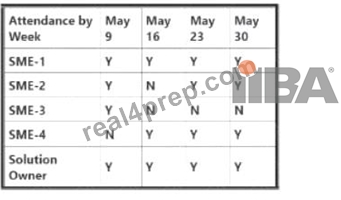
The requirements package was approved by the solution owner during the May 30 meeting. After implementation of the solution, the BA learns that the users in SME-3 s area are not using the system. Which business analysis activity should the BA have monitored more closely to mitigate this situation?
- A. Solution performance
- B. Stakeholder engagement
- C. Requirements scope
- D. Business processes
Answer: B
Explanation:
The BA should have monitored stakeholder engagement more closely to mitigate this situation. This is because stakeholder engagement is the process of ensuring that stakeholders are involved in the business analysis activities and that their needs and expectations are met. The chart shows that SME-3 did not attend any of the requirements review and approval meetings, which means that they were not engaged in the project and did not provide their feedback or approval on the requirements. This could lead to resistance or dissatisfaction with the solution. The BA should have identified and communicated with SME-3 and other key stakeholders throughout the project to ensure their buy-in and support. References:
BABOK Guide, section 2.4: Manage Stakeholder Collaboration
CCBA Practice Test, question 99
NEW QUESTION # 61
All of the following are inputs to the task assess organizational readiness except for which one?
- A. Risk register
- B. Enterprise architecture
- C. Solution Scope
- D. Stakeholder concern
Answer: A
Explanation:
Explanation
According to the BABOK Guide, the task of assessing organizational readiness involves analyzing the readiness, willingness, and ability of the stakeholders and the organization to accept, adopt, and use the solution1. This task requires inputs from various sources that provide information on the current and desired state of the organization, the solution scope and objectives, the stakeholder roles and responsibilities, and the potential impacts and risks of the change. Among the inputs listed in the question, the one that is not an input to the task of assessing organizational readiness is risk register. A risk register is an output of the task of identifying risks, which involves identifying and documenting the uncertainties that may affect the business analysis work or the solution2. A risk register is not an input to the task of assessing organizational readiness, but rather an input to the task of managing risks, which involves planning and implementing responses to the identified risks2.
The other options are all correct inputs to the task of assessing organizational readiness:
Enterprise architecture: Enterprise architecture is a description of the current and future structure and behavior of an organization's processes, information systems, personnel, and organizational sub-units3. It provides an input to the task of assessing organizational readiness, as it helps to understand the alignment, dependencies, and gaps between the current and future state of the organization and the solution1.
Solution scope: Solution scope is a description of the boundaries of the solution, including what is in and out of scope, the key assumptions and constraints, and the major features and functions3. It provides an input to the task of assessing organizational readiness, as it helps to define the scope and objectives of the change, and the expected benefits and outcomes of the solution1.
Stakeholder concern: Stakeholder concern is a statement of a need, expectation, problem, or opportunity that is relevant to one or more stakeholders3. It provides an input to the task of assessing organizational readiness, as it helps to identify and analyze the stakeholder needs, expectations, interests, and attitudes towards the change, and the potential impacts and issues that may arise from the solution1. References:
1: BABOK Guide, section 6.2 Assess Organizational Readiness, page 116
2: BABOK Guide, section 4.7 Identify Risks, page 126; section 4.8 Manage Risks, page 130
3: BABOK Guide, section 3.8 Glossary, page 516-524
NEW QUESTION # 62
As a candidate for CCBA, you should be able to recognize the activities associated with each knowledge area.
Which of the following is an elicitation process that is a part of job observation?
- A. Identifying stakeholders
- B. Defining and determining business analysis processes
- C. Planning how requirements will be approached, traced, and prioritized
- D. Job shadowing
Answer: D
Explanation:
Explanation
Job observation is a technique that involves observing and documenting the tasks, activities, and behaviors of a stakeholder or a group of stakeholders in their work environment. It helps to elicit information about the current state of the business processes, the roles and responsibilities of the stakeholders, the problems and issues they face, and the opportunities for improvement. Job observation can be done in different ways, such as:
Job shadowing: This is a process of following and observing a stakeholder as they perform their work tasks. It allows the business analyst to gain a firsthand and detailed understanding of the stakeholder's perspective, needs, challenges, and expectations. Job shadowing can also facilitate rapport and trust building between the business analyst and the stakeholder12 Video or audio recording: This is a process of capturing the work tasks and activities of a stakeholder or a group of stakeholders using a video or audio device. It allows the business analyst to review and analyze the recorded data at a later time, and to identify patterns, trends, gaps, and inconsistencies. Video or audio recording can also provide a visual or auditory evidence of the current state of the business processes3 Work sampling: This is a process of observing and recording the work tasks and activities of a stakeholder or a group of stakeholders at random intervals over a period of time. It allows the business analyst to estimate the frequency, duration, and variability of the work tasks and activities, and to measure the productivity, efficiency, and quality of the work performance. Work sampling can also provide a statistical representation of the current state of the business processes.
The other options are not elicitation processes that are part of job observation, but they are related to other business analysis knowledge areas or techniques:
Identifying stakeholders: This is a process of determining who are the individuals or groups that have an interest or influence on the project or the solution, and what are their needs, expectations, and level of involvement. It helps to plan and execute the stakeholder engagement and communication strategies, and to manage the stakeholder relationships. Identifying stakeholders is part of the business analysis planning and monitoring knowledge area.
Defining and determining business analysis processes: This is a process of establishing and documenting the business analysis approach, activities, tasks, deliverables, roles, responsibilities, and governance. It helps to plan, monitor, and control the business analysis work, and to align it with the project objectives and stakeholder preferences. Defining and determining business analysis processes is part of the business analysis planning and monitoring knowledge area.
Planning how requirements will be approached, traced, and prioritized: This is a process of defining and documenting the requirements management plan, which specifies how the requirements will be elicited, analyzed, documented, validated, verified, approved, communicated, traced, prioritized, changed, and maintained. It helps to ensure the quality, consistency, and alignment of the requirements with the stakeholder needs and expectations. Planning how requirements will be approached, traced, and prioritized is part of the business analysis planning and monitoring knowledge area.
References:
Business Analysis Techniques - ECBA, CCBA, CBAP Endorsed, Section 7.4: Requirements Elicitation, p. 79-80.
Certification of Capability in Business Analysis (CCBA®) - Simplilearn, Module 6: Elicitation and Collaboration, Lesson 6.3: Conduct Elicitation, p. 6-7.
Business Analysis Body of Knowledge (BABOK® Guide), Version 3, Chapter 4: Elicitation and Collaboration, Section 4.2: Elicitation Techniques, p. 70-71.
[Certification of Capability in Business Analysis (CCBA®) - Simplilearn], Module 6: Elicitation and Collaboration, Lesson 6.3: Conduct Elicitation, p. 8-9.
[Business Analysis Body of Knowledge (BABOK® Guide)], Version 3, Chapter 4: Elicitation and Collaboration, Section 4.2: Elicitation Techniques, p. 71-72.
[Certification of Capability in Business Analysis (CCBA®) - Simplilearn], Module 6: Elicitation and Collaboration, Lesson 6.3: Conduct Elicitation, p. 10-11.
[Business Analysis Body of Knowledge (BABOK® Guide)], Version 3, Chapter 2: Business Analysis Planning and Monitoring, Section 2.2: Plan Stakeholder Engagement, p. 34-35.
[Certification of Capability in Business Analysis (CCBA®) - Simplilearn], Module 5: Planning and Monitoring, Lesson 5.2: Conduct Stakeholder Analysis, p. 6-7.
[Business Analysis Body of Knowledge (BABOK® Guide)], Version 3, Chapter 2: Business Analysis Planning and Monitoring, Section 2.1: Plan Business Analysis Approach, p. 31-33.
[Certification of Capability in Business Analysis (CCBA®) - Simplilearn], Module 5: Planning and Monitoring, Lesson 5.1: Plan Business Analysis Approach, p. 6-7.
[Business Analysis Body of Knowledge (BABOK® Guide)], Version 3, Chapter 2: Business Analysis Planning and Monitoring, Section 2.3: Plan Business Analysis Governance, p. 36-37.
[Certification of Capability in Business Analysis (CCBA®) - Simplilearn], Module 5: Planning and Monitoring, Lesson 5.3: Plan Business Analysis Governance, p. 6-7.
NEW QUESTION # 63
The process of defining the business need uses one output. What is it?
- A. Capability gaps
- B. Business need
- C. Feasibility study
- D. Solution scope
Answer: B
Explanation:
The output of defining the business need is simply the business need.
Answer B is incorrect. The solution scope is not an output of the business need.
Answer D is incorrect. The capability gaps assessment actually uses the business need.
Answer A is incorrect. The feasibility study is not an output of the business need.
NEW QUESTION # 64
......
Pass Your IIBA Exam with CCBA Exam Dumps: https://actualtests.real4prep.com/CCBA-exam.html