


JN0-348 Exam Questions - Real & Updated Questions PDF
Pass Guaranteed Quiz 2021 Realistic Verified Free Juniper
Juniper JN0-348 Exam Topics:
| Section | Objectives |
|---|---|
| IS-IS | Describe the concepts, operation or functionality of IS-IS
Demonstrate knowledge of how to configure, monitor or troubleshoot IS-IS
|
| Spanning Tree | Describe the concepts, benefits, operation, or functionality of the Spanning Tree Protocol
Demonstrate knowledge how to configure, monitor, or troubleshoot STP and RSTP
|
| BGP | Describe the concepts, operation or functionality of BGP
Demonstrate knowledge of how to configure, monitor, or troubleshoot BGP
|
| Tunnels | Identify the concepts, requirements or functionality of IP tunneling
Demonstrate knowledge of how to configure, monitor or troubleshoot IP tunnels
|
| Layer 2 Security | Identify the concepts, benefits or operation of various Layer 2 protection or security features
Identify the concepts, benefits or operation of Layer 2 firewall filters
Demonstrate knowledge how to configure, monitor, or troubleshoot Layer 2 security
|
| Layer 2 Switching or VLANs | Identify the concepts, operation, or functionality of Layer 2 switching for the Junos OS
Describe the concepts, benefits, or functionality of VLANs
Demonstrate knowledge how to configure, monitor or troubleshoot Layer 2 switching or VLANs
|
NEW QUESTION 15
Which two statements are true about OSPF not-so-stubby areas? (Choose two.)
- A. Type 5 LSAs are translated by the ASBR into Type 7 LSAs.
- B. The ASBR originates Type 7 LSA a for redistributed external routes.
- C. Type 7 LSAs are translated by the ABR into Type 5 LSAs.
- D. The ASBR originates Type 5 LSAs for redistributed external routes.
Answer: B,C
Explanation:
Redistribution into an NSSA area creates a special type of link-state advertisement (LSA) known as type 7, which can only exist in an NSSA area. An NSSA autonomous system boundary router (ASBR) generates this LSA and an NSSA area border router (ABR) translates it into a type5 LSA, which gets propagated into the OSPF domain.
http://www.cisco.com/c/en/us/support/docs/ip/open-shortest-path-first-ospf/6208-nssa.html
NEW QUESTION 16
You need to a new ESXi host connected to port ge-0/0/1. One of the VMs configured with VLAN 10 is not reachable from any other device on the switch. To troubleshoot, you decide to verify of the VMs MAC address is learned properly under VLAN 10.
Which command would you use in this scenario?
- A. Show interfaces ge-0/01 detail
- B. Monitor interface ge-0/01
- C. Show Ethernet-switching table vlan-id 10
- D. Show vlans 10
Answer: C
NEW QUESTION 17
Click the Exhibit button.
You manage the Layer 2 network shown in the exhibit. You experience a failure on the ge-0/0/0 link between Switch-1 and Switch-2.
Which statement is correct about the expected behavior?
- A. Switch-3's ge-0/0/2 port role and state will remain as alternate and discarding.
- B. Switch-3 will remove the ge-0/0/2 interface from the RSTP topology.
- C. Switch-3's ge-0/0/2 port role and state will transition to designated and forwarding.
- D. Switch-3 will become the root bridge for the RSTP topology.
Answer: C
NEW QUESTION 18
Which two routes belong to the 172.16.0.0/22 aggregate route? (Choose two.)
- A. 172.16.0.0/24
- B. 172.16.4.0/24
- C. 172.16.5.0/24
- D. 172.16.3.0/24
Answer: A,D
NEW QUESTION 19
Referring to the exhibit, which effect does the configuration on R2 have on OSPF routing in the network?
- A. Area 2 will use a default route to reach Area 0 and Area 1.
- B. A summary route for the 192.168.10.0/24 network will be advertised to Area 0.
- C. The 192.168.10.0/24 route will not be advertised to Area 1.
- D. R2 will block traffic destined to the 192.168.10.0/24 network.
Answer: C
NEW QUESTION 20
Exhibit.
***Exhibit is Missing***
Which two statements are correct. (Choose two.)
- A. The AS path shows two hops to their IBGP routers within autonomous system 62553.
- B. The active path to2001:2244:3311:321:233::.128 will exist using interface irb.433.
- C. Route 2001:2244:3311:321:233::.128 will be advertised to an EBGP peer in AS 62553.
- D. Route 2001:2244:3311:321:233::.128 has been prepended.
Answer: B,D
NEW QUESTION 21
Which Junos feature allows you to combine multiple interface into a single bundle?
- A. NSB
- B. VRRP
- C. Virtual Classis
- D. LAG
Answer: D
NEW QUESTION 22
Click the Exhibit button.
Referring to the exhibit, which statement is correct?
- A. The spanning tree session has timed out.
- B. The bridge priority on the root device is set to 8k.
- C. This device is the root bridge.
- D. The local bridge priority is set to 8k.
Answer: B
NEW QUESTION 23
Click the Exhibit button.
The exhibit shows that Host-1 and Host-2 are attached to the switch and associated with IRB irb.1.
However, traffic sent from Host-1 to Host-2 is not blocked as expected.
Why is this problem occurring?
- A. The Block-Host-2 term does not contain the MAC address of Host-2.
- B. Intra-VLAN traffic cannot be blocked by a router-based filter.
- C. Inter-VLAN traffic cannot be blocked by a router-based filter.
- D. The block-host filter is applied in the wrong direction on theirb.1interface.
Answer: D
NEW QUESTION 24
Exhibit.
Referring to the exhibit, which statement is correct?
- A. The ge-0/0/15 interface is using the default port cost.
- B. This switch has a bridge priority of 8k.
- C. The ge-0/0/9 interface is using the default interface priority value.
- D. This switch is currently blocking all traffic.
Answer: A
NEW QUESTION 25
Your network connect to the Internet Through two different ISPs using EBGP. You must ensure that ISP1 is the primary path used for all traffic entering your network while using ISP2 as a backup path.
In this scenario, which statement is correct?
- A. You should change the next hop for all routes sent to ISP2.
- B. You should your local AS number three times on routes that you are sending to ISP2.
- C. You should assign a higher local preference on routers that you are sending to ISP1.
- D. You should use a lower MED value on routes sent to ISP1.
Answer: B
NEW QUESTION 26
Exhibit.
Referring to the exhibit, which configuration will force traffic to always use ae0.0 as long as it is active?

- A. Option C
- B. Option B
- C. Option D
- D. Option A
Answer: A
Explanation:
Explanation
https://www.juniper.net/documentation/en_US/junos/topics/topic-map/redundant-trunk-groups.html
NEW QUESTION 27
Which state indicates that the BGP session is fully converged?
- A. Connect
- B. Established
- C. Up
- D. Active
Answer: B
NEW QUESTION 28
Click the Exhibit button.
Referring to the output shown in the exhibit, which two statements are true? (Choose two.)
- A. The route is a generate route
- B. The route is active
- C. The route is not active
- D. The route is an aggregate route
Answer: A,B
NEW QUESTION 29
You are a service provider and have multiple customers in a building. You are installing a new switch that can host all of your customers.
However, you would like to ensure that one customer cannot see or broadcast to another customer. You would also like to have them use a common gateway IP address from the building.
What should be used to provide this access?
- A. private VLAN
- B. Layer 2 tunneling
- C. filter-based VLAN
- D. VLAN
Answer: A
NEW QUESTION 30
What are two interarea OSPF LSA types? (Choose two.)
- A. Type 1 router LSAs
- B. Type 3 summary LSAs
- C. Type-4 ASBR summary LSAs
- D. Type 2 network LSAs
Answer: B,C
Explanation:
A: The fourth LSA type, network example: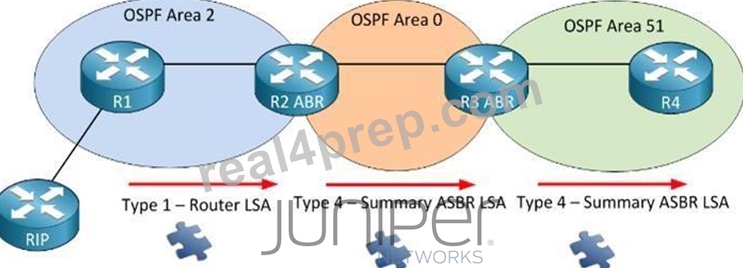
In this example we have R1 that is redistributing information from the RIP router into OSPF. This makes R1 an ASBR (Autonomous System Border Router). What happens is that R1 will flip a bit in the router LSA to identify itself as an ASBR. When R2 who is an ABR receives this router LSA it will create a type 4 summary ASBR LSA and flood it into area 0. This LSA will also be flooded in all other areas and is required so all OSPF routers know where to find the ASBR.
B: Example:
Router 2 can create a Type 3 summary LSA and flood it into area 0. This LSA will flood into all the other areas of our OSPF network. This way all the routers in other areas will know about the prefixes from other areas. Note: The name "summary" LSA is very misleading. By default OSPF is not going to summarize anything for you. There is however a command that let you summarize inter-area routes. Take a look at my OSPF summarization tutorial if you are interested. If you are looking at the routing table of an OSPF router and see some O IA entries you are looking at LSA type 3 summary LSAs. Those are your inter-area prefixes!
NEW QUESTION 31
Exhibit.
Click the Exhibit button Referring to the exhibit, what will be the IS-IS adjacency result of the configurations?
- A. A level 1 IS-IS adjacency will form
- B. A level 1 and level 2 IS-IS adjacency will form
- C. A level 2 IS4S adjacency will form
- D. No IS-IS adjacencies will form
Answer: D
NEW QUESTION 32
......
The Juniper JN0-348 is the qualifying exam for the Juniper Networks Certified Internet Specialist - Enterprise Routing and Switching (JNCIS-ENT) certification. It validates IT specialists with intermediate-level knowledge required to implement routing and switching concepts in the Juniper Junos.
Get to the Top with JN0-348 Practice Exam Questions: https://actualtests.real4prep.com/JN0-348-exam.html